Strong size-up and tactical decision-making are perishable skills. Fire officers may answer hundreds of routine calls but go weeks or months without arriving first at a significant structure fire. Incidents involving unusual construction, limited access, large commercial buildings, or rapidly changing conditions may occur even less often.
These are high-risk, low-frequency incidents. Officers cannot rely on real incidents alone to build and maintain the decision-making skills those calls demand. Frequent, focused practice keeps the size-up process active and gives officers more opportunities to make, explain, and improve tactical decisions.
What Recency Means
Recency refers to how recently someone has practiced a skill or worked through a problem. An officer may understand size-up, strategy, building construction, and tactical priorities. But when those skills have not been used recently, recognizing the problem and choosing a course of action can take longer.
Frequent practice keeps the decision-making process active. The goal is not to memorize one perfect radio report. It is to improve how officers read conditions, identify hazards, select a strategy, communicate intent, and adjust tactics as the incident changes.
High-Risk Professions Do Not Wait for Experience
Pilots use simulators to practice engine failures, equipment malfunctions, severe weather, aborted takeoffs, and other events they may never experience during an actual flight. They do not wait for an emergency to gain experience.
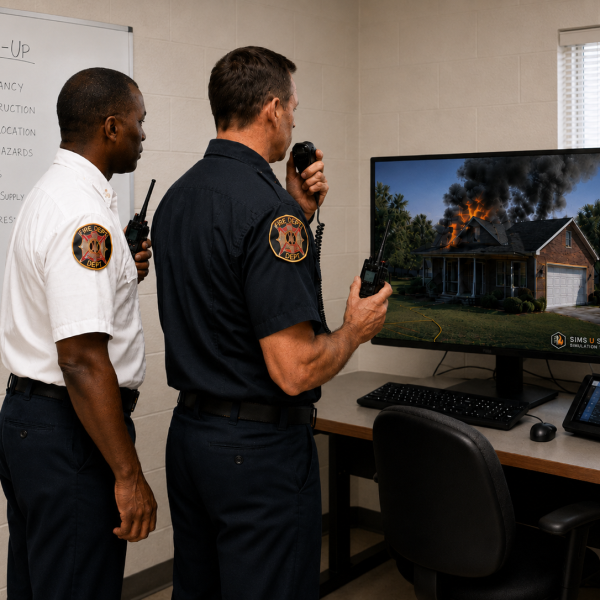
Simulation lets them make decisions, communicate, follow procedures, make mistakes, receive feedback, and repeat the exercise safely. The same principle applies to fire officers. A working fire may provide experience, but it is not a controlled learning environment. An instructor cannot pause the first five minutes, change the conditions, or let several officers take turns as the first-arriving officer. Simulation can.
Why Annual Training Is Not Enough
A two-hour strategy and tactics class in January may not remain fresh when an officer faces a difficult incident in October. Short, frequent training can be more useful than one large annual session.
- A five-minute size-up during company training
- A short developing scenario each month
- A multi-company command exercise each quarter
- An annual review of high-risk buildings in the district
This keeps tactical thinking active without overwhelming the training calendar.
Train on Local Buildings
Generic fire scenes can teach useful concepts. Local buildings make size-up and tactical practice more relevant. When officers recognize a property, they can connect visible conditions to what they already know about access, hydrants, construction, occupancy, roof design, exposures, fire protection systems, and known renovations.
A local-building scenario turns preplan information into tactical decisions. Instead of simply reviewing a photograph, ask:
- Where would the first engine and truck position?
- What belongs in the initial report?
- What is the primary life hazard?
- Which construction features create concern?
- What would you expect to find on the rear?
- What resources should be requested?
- What conditions would cause the strategy to change?
A Simple Six-Step Simulation Format
1. Choose one objective
Focus on one skill, such as the initial size-up, strategy selection, apparatus placement, resource requests, the 360-degree report, or a change from offensive to defensive operations.
2. Provide realistic dispatch information
Give officers only the information they would normally receive before arrival. Do not reveal the entire tactical problem in the dispatch.
3. Show the arrival view
Require an initial report that addresses the building, visible conditions, command, initial actions, and resource needs.
4. Ask for the reasoning
A polished radio report does not always prove that the officer understands the problem. Ask what concerns them, why they chose the strategy, what information is missing, and what would change the plan.
5. Change one condition
Add a trapped occupant report, delayed water supply, worsening smoke, roof movement, exposure involvement, or another developing problem. Require an updated incident action plan.
6. Debrief the exercise
Ask: What did you see? What did you decide? Why? What would you do differently next time? Keep feedback focused on the decision, not the person.
Better feedback: “You identified the fire location, but you did not communicate the exposure problem. How could that affect the next-arriving companies?” |
Avoid Predictable Scenarios
If every simulation begins with visible fire from a front window and ends with an offensive attack, officers may learn the exercise format instead of improving judgment. Vary the conditions without trying to trick the participant.
- Nothing showing on arrival
- Conflicting reports
- Fire visible only from the rear
- Limited staffing or water supply
- Sprinklers controlling the fire
- A defensive operation
- Conditions that improve or rapidly worsen
- A changing rescue profile
- An unusual occupancy hazard
Measure What Matters
A simple checklist can help the training division see improvement and identify patterns. Consider evaluating:
- Initial report completeness and radio clarity
- Building, occupancy, and life-hazard recognition
- Strategy selection and apparatus placement
- Resource requests and use of the 360
- Recognition of changing conditions
- Ability to explain tactical decisions
If several officers miss the same construction hazard or exposure problem, the department has identified its next training need.
Build Better Decisions Through Recency
A fire officer’s ability to size up an incident and select sound tactics should not depend on how recently that officer happened to respond to a working fire. Departments can create their own repetitions.
Frequent scenarios using local buildings allow officers to practice observation, communication, strategy, and tactical decision-making between significant incidents. The objective is not to create officers who all give the same answer. It is to develop officers who can recognize the problem, explain a defensible plan, and adjust when conditions change.
High-risk, low-frequency incidents will always involve uncertainty. Recent, repeated practice helps officers make better size-up and tactical decisions when those incidents occur.
Put Recency into Practice
Give Your Officers More Meaningful Repetitions You do not need to wait for the next working fire to practice size-up, strategy, tactics, and command decision-making. Start with the free SimsUShare simulation pack, or see how your department can build repeatable training around its own buildings and local hazards. |